Healthcare
Patient Portal & Care Coordination Platform
One secure front door to care
Illustrative solution blueprint — a representative build demonstrating our engineering approach, not a client engagement.
Overview
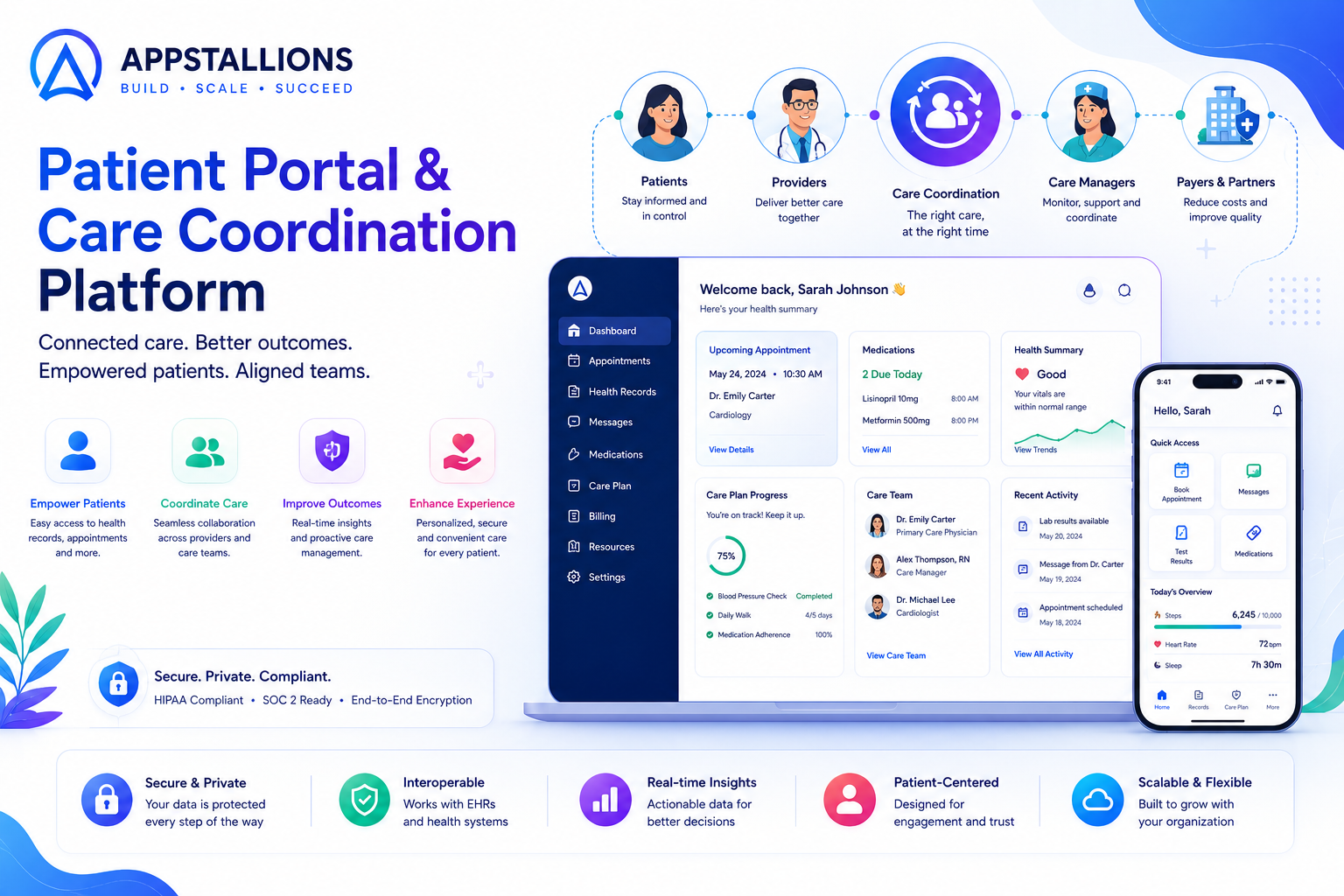
This blueprint shows how we would build a patient portal that puts appointments, medical records, prescriptions, and secure messaging behind one login. It is designed for clinics and hospital networks that want to reduce phone-based scheduling and give patients a clear view of their own care.
The build centers on a Next.js frontend backed by Node.js services and PostgreSQL. Every data path is engineered around HIPAA-aligned controls: least-privilege access, encryption in transit and at rest, and complete audit logging of record access.
The problem space
The Challenge
Healthcare providers often run scheduling, records, lab results, and billing in separate systems that never talk to each other. Patients call the front desk for anything nontrivial, staff re-key data between screens, and nobody holds a single view of a care journey. A portal that fixes this must also treat privacy as a hard constraint, because health data carries regulatory obligations that a generic web build ignores.
How we'd tackle it
Our Approach
We would start at the data boundary: an integration layer that speaks HL7 FHIR to existing hospital systems, so the portal reads from source-of-truth records instead of duplicating them. On top of that sits a role-aware API — patient, caregiver, clinician, admin — with row-level security in PostgreSQL enforcing who sees what. The interface is built mobile-first, because most patients reach it from a phone, and every sensitive action is written to an audit log.
Under the hood
Architecture
- 1
Next.js frontend with server components and a mobile-first, accessibility-conscious UI
- 2
Node.js (TypeScript) API layer exposing versioned REST endpoints per care domain
- 3
HL7 FHIR integration layer adapting to existing EHR and scheduling systems
- 4
PostgreSQL with row-level security separating patient, caregiver, and clinician access
- 5
Redis for session management and appointment-slot caching
- 6
Audit logging pipeline capturing every read and write of health records
- 7
Containerized deployment on AWS with encrypted storage and private networking
Capability surface
Key Features
The functional scope this blueprint covers end to end.
Self-service appointment booking with real-time slot availability
Medical record and lab result viewing with plain-language summaries
Secure patient–clinician messaging with attachment support
Prescription refill requests and medication history
Caregiver access with patient-controlled, scoped permissions
Automated appointment reminders over email and SMS
Telehealth-ready video visit links attached to appointments
Admin console for clinic staff to manage schedules and queues
Engineering goals
What This Blueprint Optimizes For
Design goals we engineer toward — stated as targets, not claimed results.
Page loads under two seconds on mid-range mobile devices
HIPAA-aligned handling of health data: least privilege, encryption, full audit trails
Zero double-booking under concurrent scheduling load
WCAG 2.1 AA accessibility across all patient-facing screens
Portal stays readable during upstream EHR outages via cached, clearly dated views
Roadmap thinking
Where We'd Take It Next
Wearable and home-device data ingestion for chronic-care monitoring
Multilingual interface with clinically reviewed translations
Smart intake forms that adapt questions to the visit type
Native mobile apps sharing the platform's existing API layer
Tech Stack
The technologies this blueprint is designed around.
- Next.js
- React
- TypeScript
- Node.js
- REST APIs
- PostgreSQL
- Redis
- AWS
- Docker
Related Services
Curious What This Would Look Like for You?
We'll map your requirements against a blueprint like this — architecture, stack, and roadmap — before you commit to anything.