Banking & Finance
Digital Lending & Loan Origination Platform
Credit decisions you can trace end to end
Illustrative solution blueprint — a representative build demonstrating our engineering approach, not a client engagement.
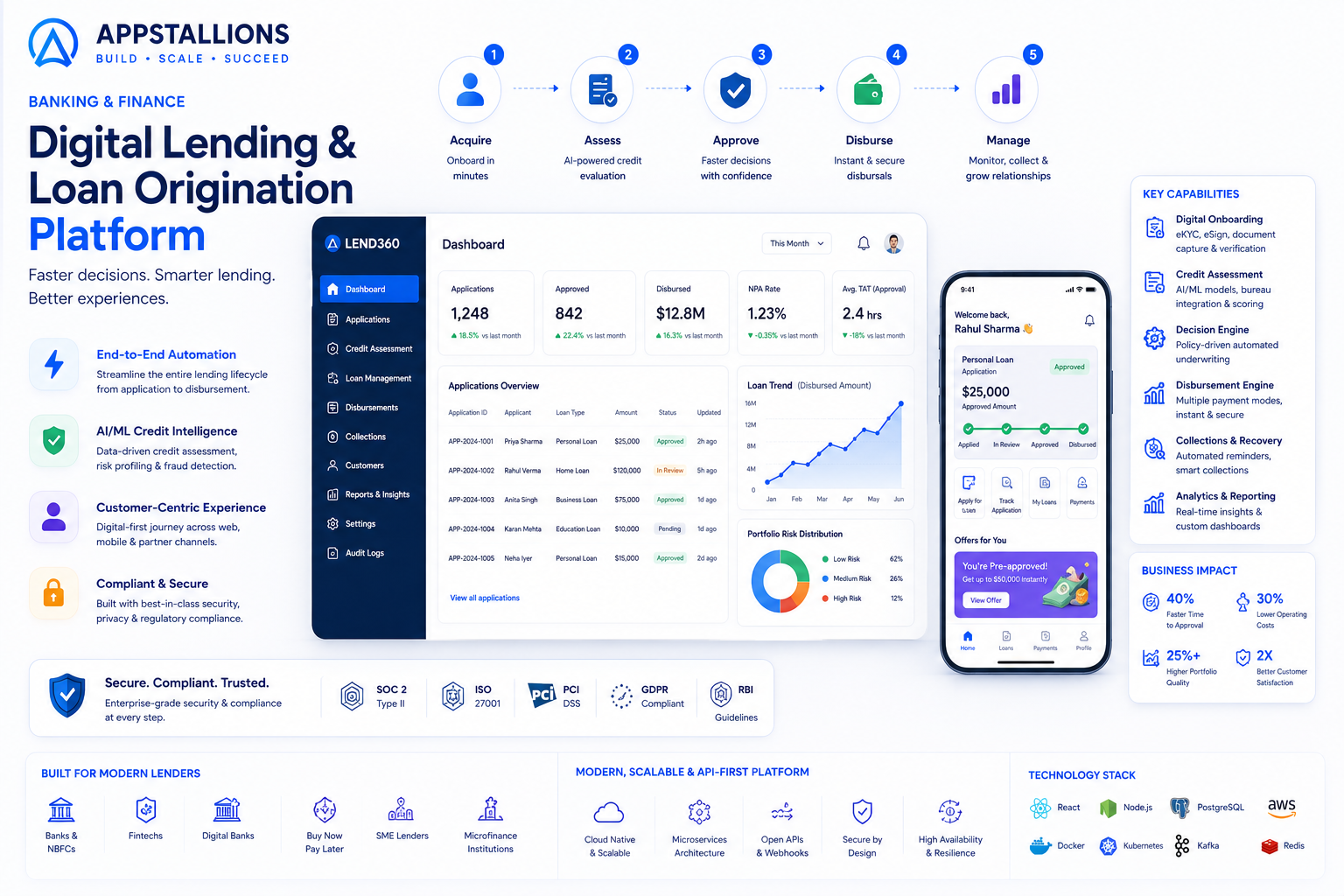
Overview
This blueprint outlines a digital lending platform covering the full origination journey: application intake, document collection, credit assessment, decisioning, and disbursal tracking. It targets NBFCs, fintechs, and lending teams inside banks that want to replace spreadsheet-and-email workflows with a real system of record.
The core is Java-based, because lending logic rewards strong typing, transactional integrity, and a long maintenance horizon. A versioned rules engine keeps credit policy out of application code, so risk teams can adjust criteria without waiting for a release.
The problem space
The Challenge
Lending operations fail in the seams: an application sits in one tool, KYC documents in another, and the credit decision in someone's inbox. That fragmentation slows approvals, hides the true pipeline from management, and makes audits painful because nobody can reconstruct who decided what, when, and on which data. A lending platform has to make the workflow fast without ever sacrificing traceability.
How we'd tackle it
Our Approach
We would model each loan as a state machine: every application moves through explicit, logged states, and no transition happens outside the workflow engine. Credit policy lives in a versioned rules layer, so every decision records its inputs and the exact policy version applied. Integrations with credit bureaus, KYC providers, and payment rails sit behind adapter interfaces, keeping third-party churn away from core logic.
Under the hood
Architecture
- 1
Java (Spring Boot) core services owning loan state, policy evaluation, and ledger entries
- 2
Loan lifecycle modeled as an explicit state machine with immutable transition logs
- 3
Versioned rules engine separating credit policy from application code
- 4
React + TypeScript back-office console for underwriters and operations teams
- 5
PostgreSQL as the transactional system of record with append-only audit tables
- 6
Redis-backed queues for document processing and bureau callbacks
- 7
Kubernetes deployment on AWS with strict per-environment isolation
Capability surface
Key Features
The functional scope this blueprint covers end to end.
Multi-step borrower application with save-and-resume
Document upload with automated completeness checks
Configurable credit scorecards and policy rules
Underwriter workbench with queues, case views, and decision capture
Credit bureau and KYC provider integrations behind pluggable adapters
Disbursal and repayment schedule tracking
Role-based access with maker–checker approval flows
Complete audit export for compliance review
Engineering goals
What This Blueprint Optimizes For
Design goals we engineer toward — stated as targets, not claimed results.
Every decision reproducible: inputs, policy version, and outcome stored together
Straight-through processing for applications that pass all policy checks
Zero loan-state changes outside the audited workflow engine
Data handling designed for regulatory audit and PCI DSS scope containment
Horizontal scaling to absorb month-end and campaign-driven application spikes
Roadmap thinking
Where We'd Take It Next
Co-lending and marketplace integrations for multi-lender participation
ML-assisted document classification and fraud signals with human review
Borrower mobile app for application tracking and repayments
Collections module with hardship and restructuring workflows
Tech Stack
The technologies this blueprint is designed around.
- Java
- React
- TypeScript
- REST APIs
- PostgreSQL
- Redis
- Kubernetes
- AWS
- JMeter
Related Services
Curious What This Would Look Like for You?
We'll map your requirements against a blueprint like this — architecture, stack, and roadmap — before you commit to anything.